
A Beach Is an Instrument
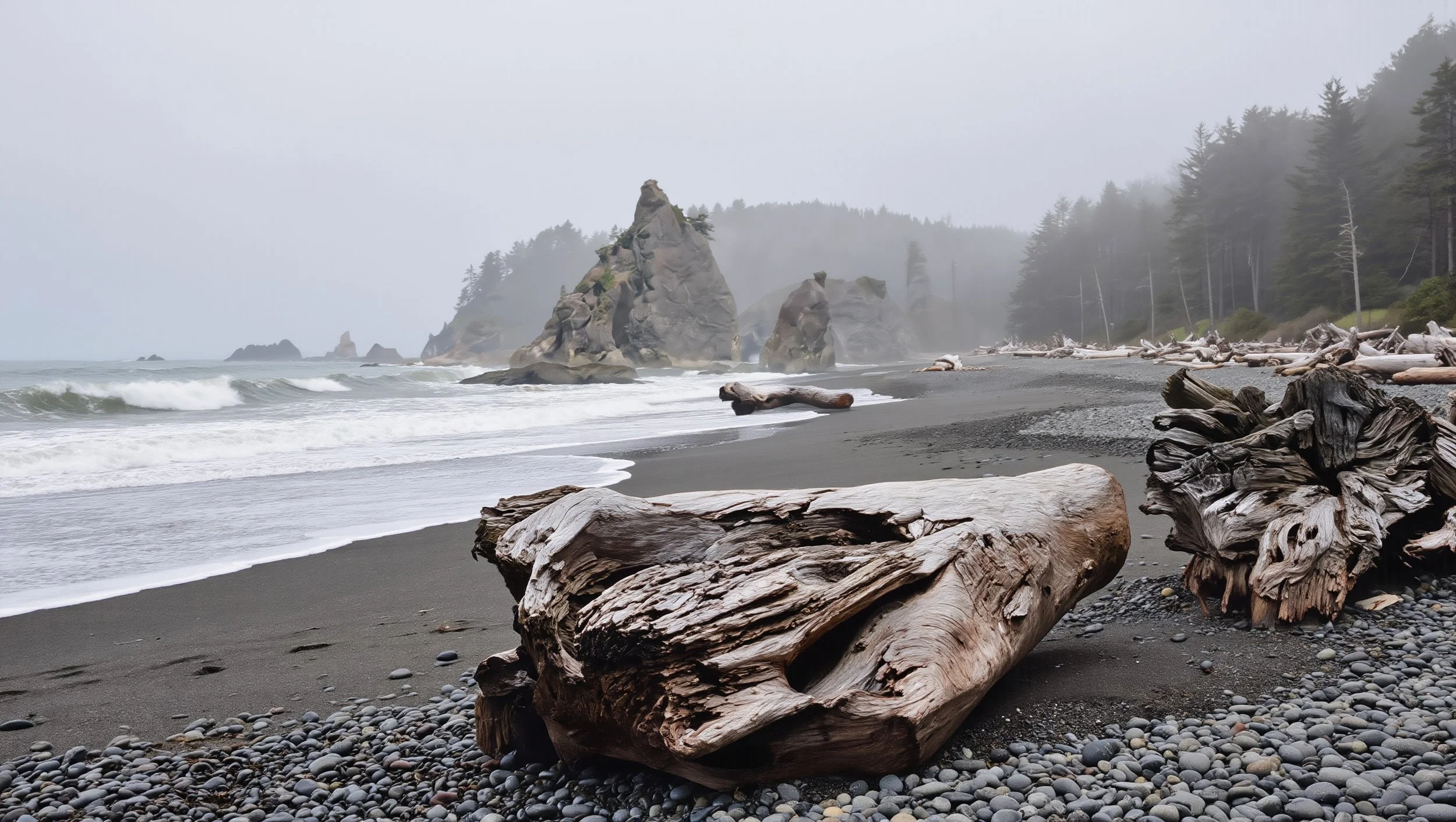
At Rialto Beach, the ocean is only half the performance. The rest is written by sand, stone, driftwood and the precise angle at which water meets land.
At Rialto Beach, the ocean is only half the performance. The rest is written by sand, stone, driftwood and the precise angle at which water meets land.
At low tide, the Pacific reaches the shore over sand. The water spreads, thins and withdraws with a low hush. A few hours later, it reaches the gravel and cobblestones. The same ocean becomes harder and more percussive. Rocks knock together beneath the wash. The retreat can sound louder than the arrival.
Higher still, beyond the cobbles, enormous pieces of driftwood lie along the beach. Many are Sitka spruce carried down rivers and returned to land by winter storms. Some have hollowed with age. When the surf reaches them, the beach acquires something close to a bass section.
It is all routinely filed under “ocean sounds.”
Rialto sits on the Pacific edge of Olympic National Park in Washington State: a steep, restless strip of coast where sand, gravel, stone and fallen trees occupy different bands of the shore. As the tide moves through them, the composition changes.
The acoustic ecologist Gordon Hempton has recorded all over the world, but he considers Rialto a personal favorite. In a recent SFGATE story about the beach, he described it as having four seasons of surf sounds. He has also called a hollow Sitka spruce log “nature’s largest violin.”
The language sounds fanciful until you sit with the mechanics of it.
We tend to credit water with the sound of water. Much of the familiar voice of breaking surf, however, comes from air. When a wave collapses, it traps pockets of air beneath the surface. Those bubbles vibrate as they form, each releasing a tiny pulse of sound. Larger bubbles produce lower tones; smaller ones ring higher. What reaches us as a single crash is partly an unruly population of brief, differently pitched events.
Then the shore joins in.
Water strikes stone. Pebbles collide and scrape. Sand absorbs energy differently from cobble. Hollow wood resonates. The slope of the beach changes how the wave breaks; wind and tide decide how forcefully it arrives. Alter any one of these conditions and the same body of water produces a different performance.
The instrument metaphor is not entirely a metaphor.
A violin string can vibrate on its own, but the body of the violin gives that vibration its audible character. Rialto does something similar at monumental scale. The Pacific provides the movement. The coast gives it form.
This is one of the quiet revelations of field recording. A photograph is naturally good at nouns: sea stack, horizon, log, stone. A recording catches the verbs. Water dragging. Rocks turning. Air escaping. Wood resonating. The tide reorganizing the entire arrangement while no one appears to be doing anything at all.
Sound reveals landscape as an event.
We have nevertheless developed broad, convenient names for the sounds of nature. Ocean. Rain. River. Waterfall. They work well enough as filing systems. As descriptions, they leave most of the interesting information out.
Rain meeting a broad tropical leaf does not sound like rain entering a stand of conifers. A river moving over glacial boulders does not sound like one passing through a deep, slow channel. A waterfall is shaped by its height, volume, rock face, plunge pool and the cavity of air surrounding it. The water matters. So does everything it touches.
Acoustic ecology calls the non-biological sounds of a place—wind, water, rain and geological movement—geophony. The term can make these sounds seem elemental and anonymous, as if the same handful of forces simply repeats itself around the world. Rialto suggests the opposite. Even the most elemental sound is local.
The coastline has an acoustic identity because it has a physical history. Its stones have been eroded and sorted by years of wave action. Its logs began inland, entered rivers and crossed an uncertain distance before returning to shore. Its sea stacks are the resistant remains of rock the Pacific has been editing for centuries. What we hear is not simply water. It is water encountering everything that happened there before it arrived.
That identity is also vulnerable.
The National Park Service monitors Olympic’s soundscapes, documenting the frequency, intensity and duration of natural and human-made sound. The measurements help the park understand the effects of vehicle traffic, construction, military aircraft and commercial overflights.
This work recognizes something our eyes can miss. A coastline may remain visually magnificent while its quieter details become harder to hear. Noise does not need to destroy the instrument to alter the experience. It only needs to play over it.
Protecting a natural soundscape is therefore not the same as protecting silence. Rialto is hardly silent. It is loud, shifting and occasionally thunderous. What deserves protection is the ability of the place to sound like itself.
No recording can contain the whole of it. A microphone captures one position, one tide, one set of weather conditions, one brief arrangement of a place that will have rearranged itself by tomorrow. That limitation is also what gives a field recording its value. It does not preserve “the ocean.” It preserves this meeting with the ocean.
This is why source matters to WILDSOUND. A sound detached from place can still relax us, help us concentrate or briefly cover the machinery of daily life. A sound returned to its source can do something more. It can reveal the particular world that made it.
Water moves everywhere. It becomes audible by meeting somewhere.
At Rialto, that somewhere is a steep coast, shifting stone, hollow spruce and a tide that never plays the same arrangement twice.
The ocean arrives. Rialto plays back.
Sources
Amy Graff. “Why soundscape experts are obsessed with this Olympic National Park beach.” SFGATE, September 12, 2026.
National Park Service. “Soundscapes: Olympic National Park.”
Grant B. Deane. “What Can We Learn from Breaking Wave Noise?” Acoustical Society of America, 2017.
Mahdi Derakhti et al. “Sound amplitude of discrete bubbles entrained by a breaking wave.” The Journal of the Acoustical Society of America, 2025.