
A Beach Is an Instrument
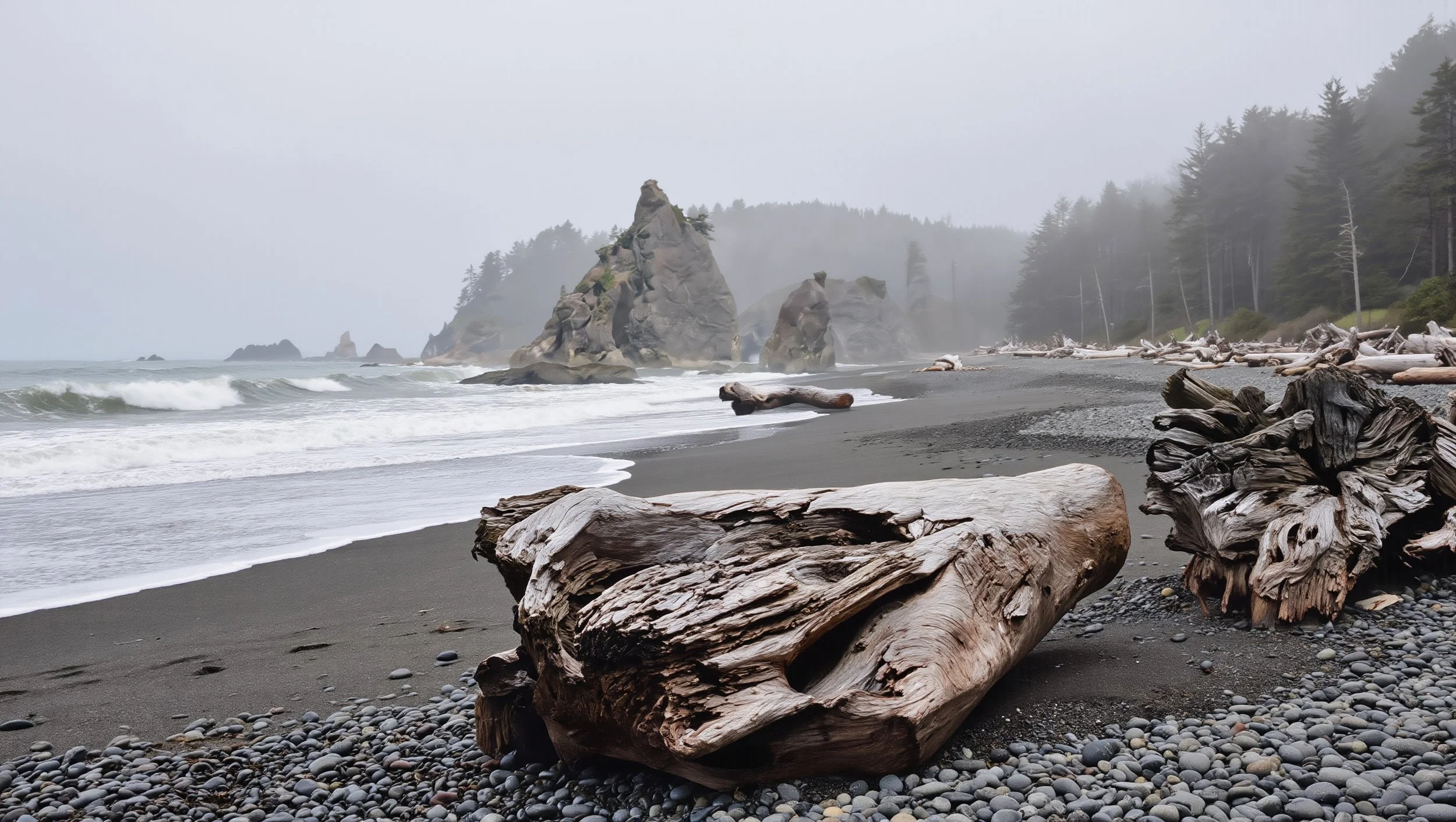
At Rialto Beach, the ocean is only half the performance. The rest is written by sand, stone, driftwood and the precise angle at which water meets land.
At Rialto Beach, the ocean is only half the performance. The rest is written by sand, stone, driftwood and the precise angle at which water meets land.
At low tide, the Pacific reaches the shore over sand. The water spreads, thins and withdraws with a low hush. A few hours later, it reaches the gravel and cobblestones. The same ocean becomes harder and more percussive. Rocks knock together beneath the wash. The retreat can sound louder than the arrival.
Higher still, beyond the cobbles, enormous pieces of driftwood lie along the beach. Many are Sitka spruce carried down rivers and returned to land by winter storms. Some have hollowed with age. When the surf reaches them, the beach acquires something close to a bass section.
It is all routinely filed under “ocean sounds.”
Rialto sits on the Pacific edge of Olympic National Park in Washington State: a steep, restless strip of coast where sand, gravel, stone and fallen trees occupy different bands of the shore. As the tide moves through them, the composition changes.
The acoustic ecologist Gordon Hempton has recorded all over the world, but he considers Rialto a personal favorite. In a recent SFGATE story about the beach, he described it as having four seasons of surf sounds. He has also called a hollow Sitka spruce log “nature’s largest violin.”
The language sounds fanciful until you sit with the mechanics of it.
We tend to credit water with the sound of water. Much of the familiar voice of breaking surf, however, comes from air. When a wave collapses, it traps pockets of air beneath the surface. Those bubbles vibrate as they form, each releasing a tiny pulse of sound. Larger bubbles produce lower tones; smaller ones ring higher. What reaches us as a single crash is partly an unruly population of brief, differently pitched events.
Then the shore joins in.
Water strikes stone. Pebbles collide and scrape. Sand absorbs energy differently from cobble. Hollow wood resonates. The slope of the beach changes how the wave breaks; wind and tide decide how forcefully it arrives. Alter any one of these conditions and the same body of water produces a different performance.
The instrument metaphor is not entirely a metaphor.
A violin string can vibrate on its own, but the body of the violin gives that vibration its audible character. Rialto does something similar at monumental scale. The Pacific provides the movement. The coast gives it form.
This is one of the quiet revelations of field recording. A photograph is naturally good at nouns: sea stack, horizon, log, stone. A recording catches the verbs. Water dragging. Rocks turning. Air escaping. Wood resonating. The tide reorganizing the entire arrangement while no one appears to be doing anything at all.
Sound reveals landscape as an event.
We have nevertheless developed broad, convenient names for the sounds of nature. Ocean. Rain. River. Waterfall. They work well enough as filing systems. As descriptions, they leave most of the interesting information out.
Rain meeting a broad tropical leaf does not sound like rain entering a stand of conifers. A river moving over glacial boulders does not sound like one passing through a deep, slow channel. A waterfall is shaped by its height, volume, rock face, plunge pool and the cavity of air surrounding it. The water matters. So does everything it touches.
Acoustic ecology calls the non-biological sounds of a place—wind, water, rain and geological movement—geophony. The term can make these sounds seem elemental and anonymous, as if the same handful of forces simply repeats itself around the world. Rialto suggests the opposite. Even the most elemental sound is local.
The coastline has an acoustic identity because it has a physical history. Its stones have been eroded and sorted by years of wave action. Its logs began inland, entered rivers and crossed an uncertain distance before returning to shore. Its sea stacks are the resistant remains of rock the Pacific has been editing for centuries. What we hear is not simply water. It is water encountering everything that happened there before it arrived.
That identity is also vulnerable.
The National Park Service monitors Olympic’s soundscapes, documenting the frequency, intensity and duration of natural and human-made sound. The measurements help the park understand the effects of vehicle traffic, construction, military aircraft and commercial overflights.
This work recognizes something our eyes can miss. A coastline may remain visually magnificent while its quieter details become harder to hear. Noise does not need to destroy the instrument to alter the experience. It only needs to play over it.
Protecting a natural soundscape is therefore not the same as protecting silence. Rialto is hardly silent. It is loud, shifting and occasionally thunderous. What deserves protection is the ability of the place to sound like itself.
No recording can contain the whole of it. A microphone captures one position, one tide, one set of weather conditions, one brief arrangement of a place that will have rearranged itself by tomorrow. That limitation is also what gives a field recording its value. It does not preserve “the ocean.” It preserves this meeting with the ocean.
This is why source matters to WILDSOUND. A sound detached from place can still relax us, help us concentrate or briefly cover the machinery of daily life. A sound returned to its source can do something more. It can reveal the particular world that made it.
Water moves everywhere. It becomes audible by meeting somewhere.
At Rialto, that somewhere is a steep coast, shifting stone, hollow spruce and a tide that never plays the same arrangement twice.
The ocean arrives. Rialto plays back.
Sources
Amy Graff. “Why soundscape experts are obsessed with this Olympic National Park beach.” SFGATE, September 12, 2026.
National Park Service. “Soundscapes: Olympic National Park.”
Grant B. Deane. “What Can We Learn from Breaking Wave Noise?” Acoustical Society of America, 2017.
Mahdi Derakhti et al. “Sound amplitude of discrete bubbles entrained by a breaking wave.” The Journal of the Acoustical Society of America, 2025.
The Forest, for the Record
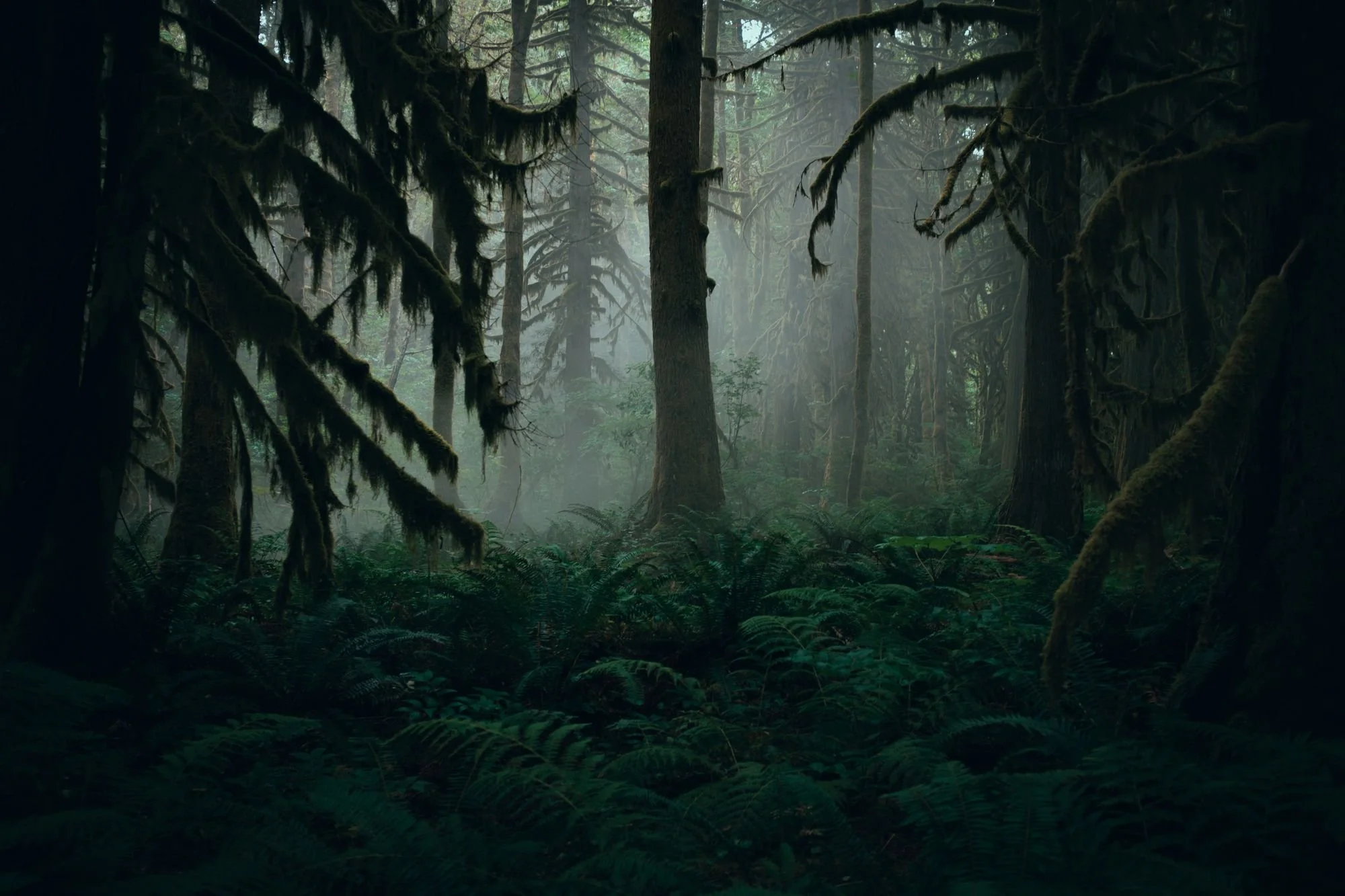
The trouble with ecological loss is that it tends to remove its own witnesses. By the time a place sounds quiet enough to alarm us, quiet may already feel normal.
The trouble with ecological loss is that it tends to remove its own witnesses. By the time a place sounds quiet enough to alarm us, quiet may already feel normal.
A child grows up beside a river with fewer fish than it held a generation earlier and calls it normal. A young biologist begins work in a forest that has already lost half its species and calls it a baseline. The change may be measurable. The memory of what came before is not always so cooperative.
The marine biologist Daniel Pauly gave this problem a name in 1995: shifting baseline syndrome. Each generation inherits a slightly diminished natural world, then mistakes the condition in which it found that world for the condition in which it began. The baseline moves. Our expectations politely move with it.
A new study in Global Change Biology is attempting to pin one part of that baseline down.
The Soundscape Baselines Project, led by forest ecologist Zuzana Buřivalová and an international network of local scientists, conservation practitioners, community members, and Indigenous partners, has begun building a permanent acoustic record of some of the world’s remaining intact forests.
The first phase spans six places: Andulau Forest Reserve in Brunei; Tiputini Research Station in Ecuador; Ibola Dja Bana Ba Massaha in Gabon; Bavarian Forest National Park in Germany; Manu Biological Station in Peru; and the Baraboo Hills in Wisconsin.
At each location, six recorders were placed at separate sites and left to listen continuously. 24 hours a day, for at least 365 days. Camera traps watched nearby. Local teams returned each month to change batteries, collect memory cards, and keep the long act of attention going.
The project defines an intact forest as one with minimal human influence, including no commercial timber extraction for at least forty years. That does not make these places untouched. Few places are. It makes them reference points: living examples of what a relatively complete forest sounds like across dawns, storms, migrations, dry spells, insect seasons, and all the less cinematic hours between them.
This matters because trees are easier to count than absences.
Satellites can show whether a canopy remains. Cameras can document animals that pass in front of them. A microphone captures a different layer of the place: birds, frogs, insects, mammals, rain, wind, branchfall, engines, aircraft…every audible participant, whether or not a researcher already knows its name.
That last part may be the most important. The scientists do not need to identify every sound today in order to preserve it. Bioacoustic tools are still developing, and many species remain difficult to recognize by call alone. The recordings can be revisited as the science improves. A voice that is anonymous now may become legible years from now.
It is a time capsule designed to become more informative with age.
The project’s early analyses found that the intact forests carried distinctive acoustic signatures, with recognizable daily patterns shared across sites in the same forest. They also found a useful warning for anyone tempted to reduce a living system to one tidy score: time of day matters.
Broad averages can make two forests appear similar while concealing meaningful differences in how their sound rises, falls, and reorganizes over twenty-four hours.
Even a forest can disappear inside a spreadsheet.
Conservation has spent decades making nature legible to systems that prefer numbers: hectares protected, carbon stored, species counted, credits issued. These measures are necessary. They are also incomplete.
A forest can remain green from above while becoming simpler below the canopy. Without a reliable reference, a restoration project may be compared with another diminished place and still look like success.
An acoustic baseline gives the comparison somewhere honest to begin.
For WILDSOUND, the idea feels familiar. A recording from a named place, made at a particular moment and preserved with its context, is more than an appealing sound. It is a document. Remove the source and it becomes ambience. Preserve the source and it can carry memory.
This is why “forest” is never quite enough. The sound of Manu belongs to Manu. The sound of Tiputini belongs to Tiputini. Each place has its own arrangements, repetitions, interruptions, and silences. To flatten them into a category is to discard some of the information that makes them worth hearing in the first place.
A recording cannot protect a forest by itself. Neither can a photograph, a map, or a scientific paper. But it can protect something conservation needs before meaningful action is possible: an honest memory of what was there.
Sometimes the first thing a place loses is not a species. It is our ability to notice that the species has gone.
The forest is being put on the record. We should listen while the witnesses are still speaking.
Sources
Buřivalová, Z. et al. (2026). “Bioacoustic Baselines for Intact Forests.”Global Change Biology, 32(5).
Soundscape Baselines Project, Sound Forest Lab, University of Wisconsin–Madison.
Pauly, D. (1995). “Anecdotes and the Shifting Baseline Syndrome of Fisheries.”Trends in Ecology & Evolution, 10(10), 430.
The Active Ear
There is a profound difference between letting sound wash over you as a barrier to the world, and stepping into the sound as an anchor.
There is a profound difference between letting sound wash over you as a barrier to the world, and stepping into the sound as an anchor.
Most of us use nature sounds as a digital partition. We turn on "rain" or "ocean" to drown out the hum of traffic, the clatter of the office, or the circular loop of our own thoughts. It is a defensive act. We use the sound to build a wall.
But when you use geolocated, authentic soundscapes, you have the opportunity to practice something much older: active, place-based meditation. Instead of shutting the world out, you are letting a very specific part of the living earth in.
Here is a three-step framework to transition your daily listening from a passive utility to an active, restorative practice.
1. Identify the Landscape Architecture
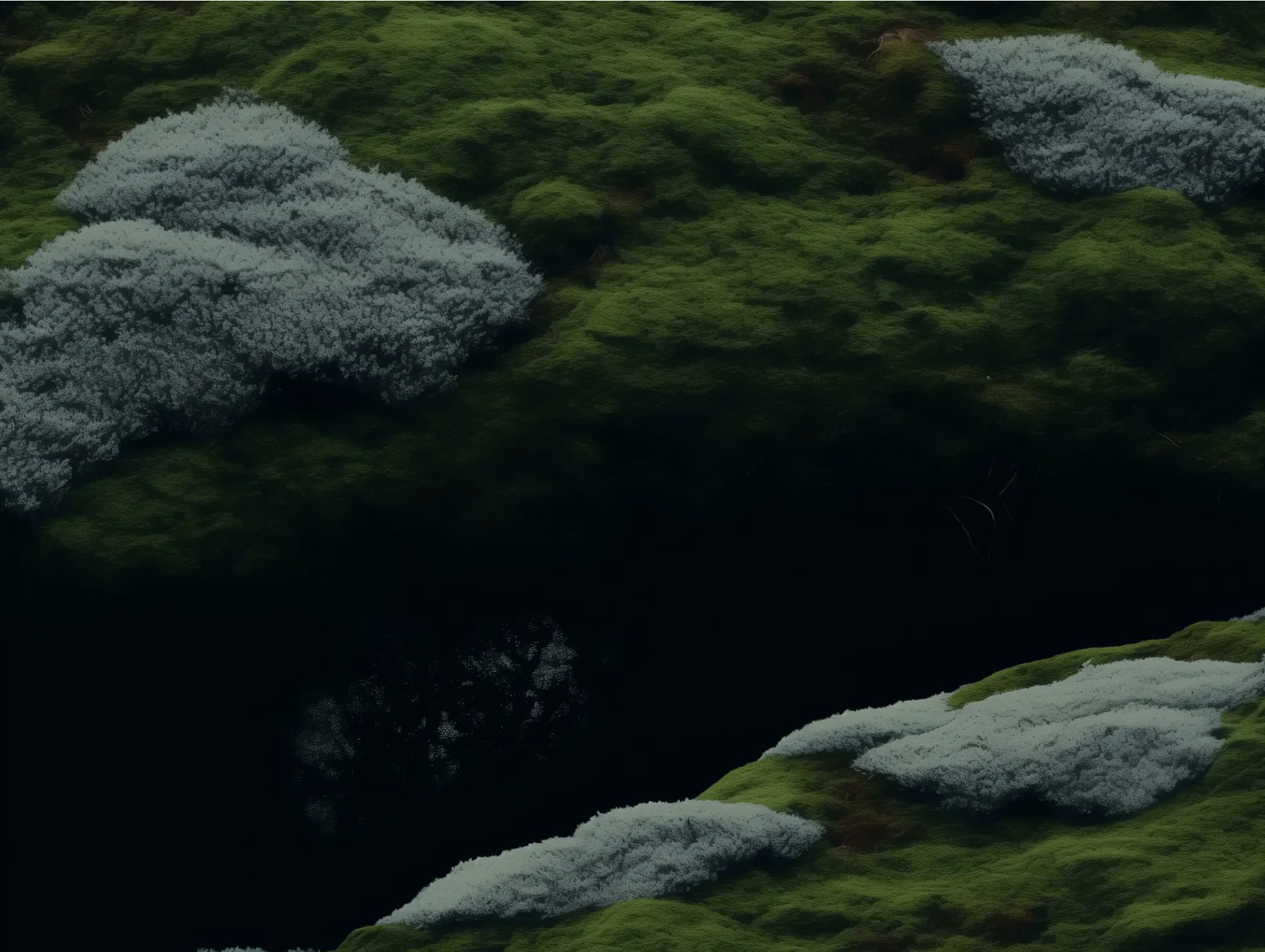
Before you close your eyes, take a moment to look at where you are traveling. Is it the mossy undergrowth of the Olympic Peninsula’s Bogachiel Rain Forest? Or the stark, dramatic drop of Helmcken Falls?
Knowing the name, the coordinates, and the physical reality of the place gives your mind a concrete anchor. You aren't listening to a digital abstraction; you are placing your attention at a real point on the map.
2. Isolate the Layers (Geophony vs. Biophony)
Once the soundscape begins, do not let it blur into a single drone. Use your attention like a camera lens, zooming in on different layers of the environment:
Track the Geophony: Listen for the non-biological elements. Can you hear the specific texture of the water—is it a wide, flat river rushing over smooth stones, or the high-impact mist of a vertical waterfall?
Isolate the Biophony: Shift your attention to the biological voices. Listen for the spacing between bird calls, or the rhythmic pulse of insects. Notice how the species have evolved to occupy different sonic niches, leaving room for one another to be heard.
3. Breathe with the Flow
Nature does not loop. Authentic ecosystems are dynamic, continuously breathing networks of relationships. As you listen, let your breath settle into the natural pace of the environment. If your mind begins to wander, do not fight the thoughts. Simply pick a single sound—a particular bird call, or the steady, rhythmic crash of water—and follow it back to the center.
"A person can be educated in three ways: the ear, the eye, and the hand." — R. Murray Schafer
By training your ear to listen to the specific, unfiltered reality of these pristine places, you aren’t just calming your nervous system. You are rebuilding a relationship with the wild earth, one coordinates-backed soundscape at a time.
Acoustic Ecology
The field of acoustic ecology has spent fifty years making the case that how we listen matters. WILDSOUND is, in its way, an attempt to put that case into practice.
There's a field of science devoted to the sounds of wild places—what they contain, what we lose when they change, and what it means to truly hear them.
In 1969, a Canadian composer named R. Murray Schafer introduced an idea that was simple enough to seem obvious and radical enough to take decades to absorb: that sound is an environment, and that the health of a place can be heard.
He called this acoustic ecology. The study of the relationship between living organisms—humans, animals, ecosystems—and the soundscapes they inhabit. Schafer believed that the sounds of a place contain information about it. That a healthy forest sounds different from a degraded one. That rivers have acoustic signatures. That the way we listen, and what we choose to listen to, reflects and shapes our relationship to the natural world.
Fifty-plus years later, the field has expanded into a formal science, with researchers like Bernie Krause—who has spent decades recording wild places and cataloguing the acoustic impact of habitat loss—building the evidence that Schafer intuited. Krause's recordings of Lincoln Meadow in California's Sierra Nevada, taken before and after selective logging in 1988, became one of the field's most cited demonstrations: the forest looked the same before and after. On tape, it had gone nearly silent.
The central insight of acoustic ecology is one that takes a moment to fully land: soundscapes are data. They are not just pleasant backgrounds or mood modifiers—they are real-time evidence of ecological health. A dawn chorus rich with overlapping species is a different thing, scientifically and experientially, from a simplified soundscape with fewer layers. The difference between them is the difference between a thriving system and a diminished one.
Krause formalized this into what he calls the three-part architecture of natural soundscapes: geophony (non-biological sounds—wind, water, rain), biophony (the sounds of living organisms—insects, birds, frogs, mammals), and anthrophony (sounds produced by humans). In a healthy ecosystem, these layers coexist in something close to acoustic cooperation. Species have evolved to occupy different frequency bands, different times of day, different sonic niches. When that balance is disrupted—by development, by logging, by climate-driven species loss—the soundscape collapses inward.
This is not a metaphor. You can hear it.
What does this mean for how we listen?
It means that a field recording from a named wild place is not just an audio file. It is a document. When WILDSOUND records the dawn sounds of Manu National Park in Peru—1.7 million hectares spanning lowland rainforest, cloud forest, and Andean grassland, home to over 1,000 bird species and one of the densest concentrations of life on earth—what you're hearing is a bioacoustic portrait of one of the most ecologically intact systems left on the planet. That information is in the sound. The complexity, the layering, the presence of species that don't exist anywhere else.
Hearing it as "jungle sounds" is like standing in front of a Velázquez and seeing "an old painting."
Acoustic ecology also offers a framework for understanding what is at stake when wild soundscapes disappear. This is not only an aesthetic loss, though it is that. It is an informational one. As species vanish and habitats simplify, the soundscapes they produced—soundscapes that took thousands of years of co-evolution to compose—disappear with them. Unlike visual records or written documentation, they cannot be reconstructed from memory. They existed in real time, in real places, and when those places change beyond recovery, the sounds do too.
Schafer called this the "lo-fi soundscape problem"—environments so saturated with human-generated noise that the detail of the natural world becomes inaudible. He was describing cities, but the concept extends further. We've created a lo-fi culture of nature listening: high volume, low resolution, no source. Rain tracks with no rain. Forest sounds with no forest behind them.
The antidote is not complicated. It is what acoustic ecology has always proposed: listen with attention. Listen to specific places. Know what you're hearing and why it sounds the way it does. Understand that the sounds of wild places are not content—they are conditions, and conditions change.
WILDSOUND was built in the spirit of that proposition. Each soundscape in the library is a named place with a real acoustic identity—the geophony of Vatnajökull's glacial rivers in Iceland, the biophony of Sinharaja Forest Reserve in Sri Lanka, whose 36,000 hectares shelter over 60 percent of the island's endemic species. These are not interchangeable. They are specific. And their specificity is what makes them worth protecting.
The field of acoustic ecology has spent fifty years making the case that how we listen matters. WILDSOUND is, in its way, an attempt to put that case into practice.
R. Murray Schafer once wrote that "a person can be educated in three ways: the ear, the eye, and the hand." He thought the ear had been neglected for most of recorded history. He spent his life trying to correct that.
The sounds are still out there. Most of them, for now. The question is whether we're actually listening.
What Nature Sound Apps get Wrong
Nature sound apps have solved half the problem. They've made the therapeutic benefits of wild places accessible to people who live far from them. That's not nothing. The other half (the part that asks where those places are, what's happening to them, and whether our listening leaves anything behind) remains almost entirely unaddressed.
They figured out that nature sounds work. They just didn't ask where nature sounds come from.
There's a scene that plays out millions of times a day. Someone opens an app, taps "forest," and lets the sound run while they work, sleep, or try to come down from a difficult afternoon.
The science behind this is solid. Nature sounds reduce cortisol. They lower heart rate. They shift the brain from an inward, ruminative state toward an outward, attentive one. A 2017 University of Sussex study found that participants listening to natural soundscapes showed measurably different neural activity than those exposed to artificial sound. Patterns associated with rest, focus, and reduced anxiety.
The apps are delivering something real. The problem isn't whether nature sounds work. The problem is what they're not telling you about the nature sounds they're selling.
Open almost any meditation or sleep app and look at how the nature sounds are labeled. You'll find: Forest. Rain. River. Ocean. Waterfall. Jungle. Categories, not places. They tell you the type of sound the way a grocery store label tells you something is "fruit." They carry no information about origin, ecology, or the actual existence of a specific living system that was recorded.
This isn't an oversight. It's a design choice. And it has consequences.
When a sound is labeled "forest," no one asks: which forest? Where? Is it threatened? Does it have a name? Is it still there? The sound becomes a commodity. Extracted from its source, processed for consumer use, offered back at a monthly subscription rate with no attribution, no context, and no mechanism for contributing to the thing being consumed.
This is, in structure, the same logic that has driven the degradation of natural soundscapes in the physical world. We take what's useful. We don't pay royalties to the source.
The deeper issue is what this model does to connection.
The therapeutic benefits of nature sounds are real, but they exist on a spectrum. Passive listening to a generic "rain" track is one end. Knowing you're hearing the Oirase Stream in Japan's Aomori Prefecture, a waterway recognized by the Ministry of the Environment as one of the 100 Soundscapes of Japan, whose beech forests are a UNESCO World Heritage Site, whose banks are alive with the Japanese serow and 87 bird species, is something else. The sound hasn't changed. The relationship to it has.
Researchers studying nature connection consistently find that specificity matters. The more we understand what we're encountering in the natural world, the more likely we are to develop genuine attachment to it. Names, context, and ecological knowledge don't make the listening experience more clinical. They make it more real.
Generic labels quietly prevent that. They keep the listener at the surface.
There's also the question of what comes next. Even if a nature sound app could deliver profound connection, even if "forest" were somehow enough, what would a listener do with that feeling? Where would the response go?
Most apps offer no answer. There's no pathway from the emotion to the action. No way to support the ecosystem behind the sound, to learn about the conservation pressures it faces, to direct even a small portion of the subscription fee back toward its preservation. The loop stays open.
WILDSOUND was built to close it. Every soundscape in the library is tied to a named location, real coordinates, ecological context, and conservation status. Every subscription supports named NGO partners doing active work in these ecosystems. The Odzala-Kokoua National Park in the Republic of Congo, where African Parks manages 13,500 square kilometers of ancient rainforest. The Simien Mountains in Ethiopia, home to the endangered walia ibex and the endemic Ethiopian wolf. Madidi National Park in Bolivia, named by the Wildlife Conservation Society as the most biologically diverse national park on Earth.
These are not categories. They are places. And the distinction, it turns out, changes everything.
Nature sound apps have solved half the problem. They've made the therapeutic benefits of wild places accessible to people who live far from them. That's not nothing.
The other half (the part that asks where those places are, what's happening to them, and whether our listening leaves anything behind) remains almost entirely unaddressed.
That's the gap worth closing.
What Is an Ecosound App?
An ecosound app begins with a different premise. That knowing where a sound comes from matters.
You've probably listened to rain that wasn't really rain. Or rather, rain that could have been anywhere, recorded by anyone, stripped of every quality that made it a specific thing happening in a specific place at a specific moment in time.
Most nature sound apps work this way. They traffic in categories. Rain. Forest. River. Ocean. Useful as descriptors. Not sources.
An ecosound app begins with a different premise. That knowing where a sound comes from matters. Not as a trivia detail. Not as metadata. But as the thing that transforms passive listening into something closer to genuine contact with the living world.
The distinction sounds subtle. It isn't.
When you know that what you're hearing is the Opalescent River in New York's High Peaks Wilderness, that it originates from the west face of Little Marcy Mountain, flows through pristine alpine zones before joining the Hudson, and carries the designation of a New York State Wild River, the sound changes. Not acoustically. Contextually. The river becomes a river. An individual thing with a particular existence and a particular vulnerability.
That's what naming does. It closes the distance between listener and source that generic categories quietly enforce.
This is what ecosound means. Not a new genre of audio content. A theory of listening. One that insists the source matters as much as the sound. That the way most of us consume nature sounds on meditation and sleep apps is a mild version of the same extractive logic happening to these places in the real world. We take the sound. We leave nothing behind. We don't even know what we took it from.
WILDSOUND was built around the opposite idea. Every soundscape in the library is field-recorded and geolocated. Not "rainforest," but the Bogachiel Rain Forest in Washington's Olympic Peninsula. Not "waterfall," but Helmcken Falls in Wells Gray Provincial Park, British Columbia: 141 meters of freefall over ancient volcanic rock, fourth-highest in Canada. Not "birdsong," but the Bwindi Impenetrable Forest in Uganda, where mountain gorillas move through afromontane undergrowth that has existed for tens of thousands of years.
The specificity is the point.
And then there's what comes next. An ecosound app that only names places stops halfway. WILDSOUND ties each subscription to active conservation support, through WWF, Conservation International, and The Nature Conservancy, so that listening becomes a closed loop. You hear the river. You know its name. You help protect what's left of it.
This is the working premise behind ecosound. That attention and care are connected. That the wild places we listen to have earned their royalties. That an app can be the mechanism by which we finally start paying them.
The bill has been outstanding for a long time.